
The Best Areas to Buy Luxury Property in Dubai in 2026: A Structured Market Overview

- April 2, 2026
- 5
- Real Estate
Dubai’s luxury real estate market in 2026 is defined by diversity rather than concentration. Prime property is no longer limited to a single district; instead, it spans multiple environments, each catering to different buyer priorities.
The city’s top luxury areas include established waterfront destinations, private villa enclaves, and emerging master-planned communities. These locations combine lifestyle positioning with long-term investment potential, reflecting a market that is both expanding and maturing.
For investors and end-users, selecting the right area requires understanding not only price points, but also the type of demand each district attracts and sustains.
The Evolution of Dubai’s Luxury Property Market
Dubai’s prime residential segment has entered a phase of measured and structured growth.
Key characteristics of the 2026 market include:
- Expansion of “prime” beyond traditional legacy locations
- Increased buyer selectivity based on lifestyle and long-term positioning
- Growth of both established and emerging high-end districts
Luxury property in Dubai is no longer defined solely by price or visibility, but by environment, intent, and use case.
Palm Jumeirah: Global Waterfront Benchmark
Palm Jumeirah continues to represent Dubai’s most internationally recognised luxury address.
Its defining features include:
- Limited supply of beachfront villas and branded residences
- Strong global demand from both investors and end-users
- High levels of price stability driven by scarcity
The area’s value is supported not only by its location, but by its positioning as a globally identifiable asset class within Dubai’s real estate market.
Palm Jumeirah is typically suited to:
- International investors
- Buyers prioritising exclusivity and liquidity
- High-net-worth individuals seeking long-term asset security
Emirates Hills: Ultra-Prime Privacy and Long-Term Ownership
Emirates Hills represents a different segment of the luxury market — one defined by privacy, space, and architectural individuality.
Key characteristics:
- Large plot sizes and bespoke villas
- Limited supply with long ownership cycles
- Low transaction turnover compared to other districts
Unlike more visible locations, Emirates Hills functions as a private residential enclave, where properties are held for extended periods and rarely enter the market.
This area is most relevant for:
- Ultra-high-net-worth buyers
- Long-term end-users
- Investors focused on capital preservation
Dubai Hills Estate: Master-Planned Residential Integration
Dubai Hills Estate reflects a more contemporary approach to luxury development.
Its appeal is based on:
- Integrated planning combining residential, retail, and green space
- Strong infrastructure and accessibility
- Balanced appeal to both investors and end-users
Built around a central park and golf course, the community offers a complete residential ecosystem, rather than a single-use district.
Dubai Hills Estate is typically suited to:
- Families and long-term residents
- Investors seeking stable rental demand
- Buyers prioritising livability alongside investment value
Downtown Dubai: High-Density Urban Luxury
Downtown Dubai remains the city’s primary urban core for luxury apartments and branded residences.
Its positioning is defined by:
- Proximity to major landmarks and commercial centres
- High-density vertical living
- Strong and consistent tenant demand
The area continues to attract buyers seeking immediate access to retail, hospitality, and business districts, reinforcing its liquidity and resilience.
Downtown Dubai is best suited for:
- Professionals and urban residents
- Investors seeking stable rental income
- Buyers prioritising central location over space
Dubai Marina: Liquidity and Rental Performance
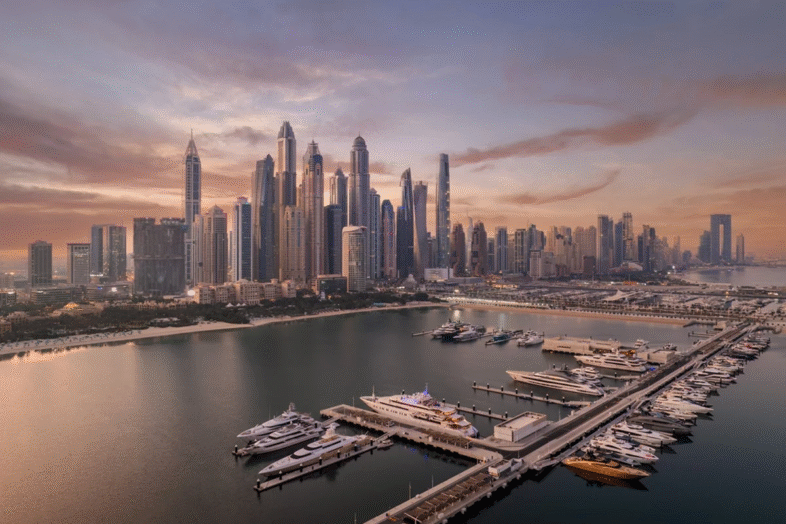
Dubai Marina remains one of the most active residential districts in the luxury segment.
Its key advantages include:
- Strong rental yields supported by consistent tenant demand
- High transaction liquidity
- Established infrastructure and lifestyle amenities
While more mature than newer developments, Dubai Marina continues to perform due to its combination of accessibility, density, and waterfront appeal.
This makes it particularly relevant for:
- Yield-focused investors
- Short- to medium-term holding strategies
- Buyers prioritising rental performance
Dubai Creek Harbour: Emerging Waterfront Growth
Dubai Creek Harbour represents a newer phase of Dubai’s luxury development strategy.
Key characteristics:
- Modern waterfront design and open skyline views
- Ongoing development with future-oriented infrastructure
- Lower entry points relative to established waterfront districts
As a developing district, it attracts buyers focused on long-term appreciation rather than immediate maturity.
Dubai Creek Harbour is suited to:
- Investors seeking growth potential
- Buyers willing to enter early-stage developments
- Long-term capital appreciation strategies
A Shift in How “Prime” Is Defined
One of the most significant changes in 2026 is the evolving definition of prime real estate.
The market is increasingly shaped by contrasts:
- Waterfront visibility vs private gated living
- Urban density vs master-planned communities
- Established prestige vs emerging growth
As a result, the “best” area is no longer universal. It is dependent on buyer intent, time horizon, and use case.
Key Considerations for Buyers
When evaluating luxury property in Dubai, buyers should consider:
- Purpose of purchase (investment, residence, or hybrid)
- Holding period (short-term vs long-term)
- Liquidity requirements
- Demand drivers specific to each location
A structured approach is increasingly necessary, as performance varies significantly across districts.
The Noble House Perspective
Dubai’s luxury real estate market in 2026 reflects a transition toward greater maturity and segmentation.
Rather than being defined by a single prime location, the market now offers multiple high-performing districts, each supported by distinct demand drivers.
For investors, the focus should remain on:
- Alignment between asset and buyer objective
- Location-specific demand sustainability
- Long-term positioning within the broader market
As the definition of luxury continues to evolve, performance will be determined less by visibility and more by fit, function, and fundamentals.
