
- April 23, 2026
- 4
- Real Estate
Prepared for clients of The Noble House Real Estate LLC
Focused on Beyond Developments, Select Group, SOL Developer, and Dubai Properties Group
Executive Summary
Dubai remains one of the most compelling real estate investment markets globally for large private investors because it combines tax efficiency, strong transaction liquidity, visible population growth, infrastructure expansion, and a broad spectrum of asset strategies ranging from high-yield apartments to waterfront appreciation plays. For a USD 10 million investor, the most prudent strategy is not single-project concentration but a diversified allocation across stability, yield, and appreciation sleeves anchored by developers with distinct market roles.
In this framework, Select Group is best positioned as the premium stabilizer, Beyond Developments as the waterfront appreciation engine, SOL Developer as the yield-plus growth sleeve, and Dubai Properties Group as the institutional-confidence and scale component. Together, these developers allow the portfolio to capture different parts of Dubai’s real estate cycle while maintaining presentation credibility for sophisticated investors.
Dubai Real Estate Market Explained
Dubai’s real estate market is driven by a combination of end-user demand, expatriate population growth, business formation, international capital inflows, tourism, and infrastructure-led urban expansion. Unlike many global cities, Dubai offers investors access to both maturing prime districts such as Dubai Marina and fast-rerating growth districts such as Dubai Maritime City, JVT, and several mixed-use corridors influenced by long-term planning policy.
The market is also unusually transparent by regional standards because investors can benchmark against Dubai Land Department transaction reporting, price indices, and active resale listings. This improves investor confidence because it allows underwriting to be based on real transaction evidence rather than only on promotional pricing.
Progression of the Dubai Market Since 2020
The 2020 period marked a cyclical low for Dubai residential pricing. Market data cited in 2026 reporting shows average price per square foot at roughly AED 872 in early 2020, rising to approximately AED 935 in 2021, then accelerating to AED 1,555 in 2024 and AED 1,692 in 2025, with February 2026 levels around AED 1,667 per square foot. This progression demonstrates a major repricing of the market rather than a short-lived post-pandemic bounce.
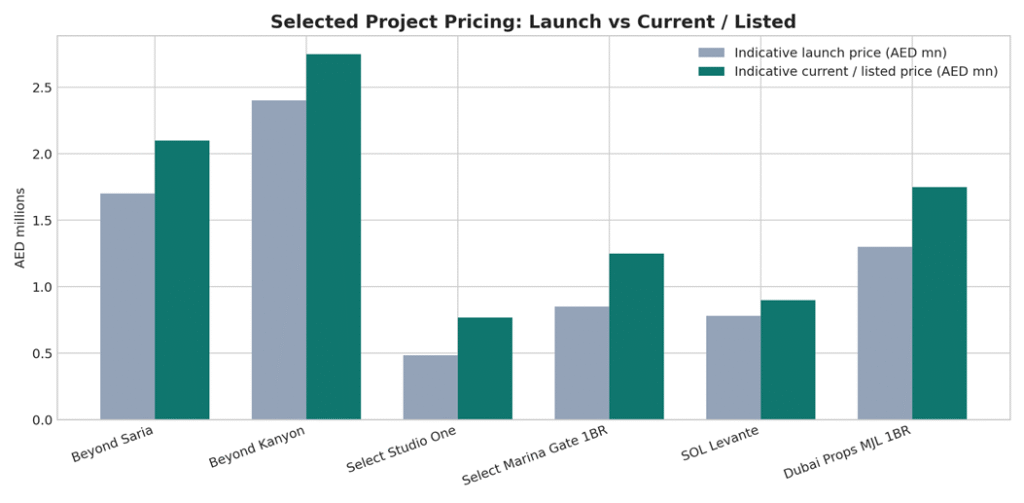
Transaction value growth reinforces the same conclusion. Dubai recorded over 84,196 transactions worth almost AED 300 billion in 2021, H1 2025 sales worth AED 262.7 billion, and full-year 2025 transaction value reported at AED 682.5 billion across more than 214,000 sales, indicating both capital depth and persistent participation.
What Investors Need to See for a USD 10 Million Ticket
- Gross rental yield and net yield after service charges, leasing fees, management costs, furnishing, and vacancy assumptions.
- Capital appreciation path, including launch-to-current price movement and expected rerating by district maturity.
- Developer execution credibility, including delivered projects, construction control, parent-company support, and handover quality.
- District liquidity, measured by active transaction flow, depth of tenant demand, and ability to exit without major discounting.
- Supply pipeline and risk of competitive handovers in the same micro-market over the next 24 to 48 months.
- Alignment with macro demand drivers such as population growth, job creation, tourism growth, and the Dubai 2040 Urban Master Plan.
Dubai 2040 Urban Master Plan and Why It Matters
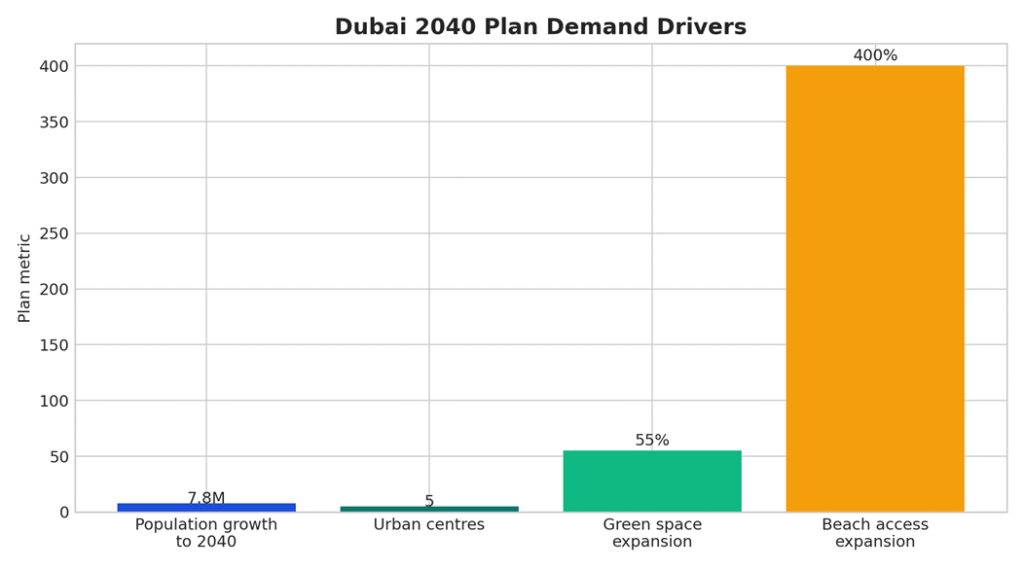
The Dubai 2040 Urban Master Plan is central to any long-horizon investor presentation because it gives a planning-led explanation for future demand. Official and closely aligned planning sources describe a pathway toward approximately 7.8 million residents by 2040, development of five urban centres, expansion of green and recreational space, and a more integrated approach to land use, transit, and mixed-use living.
For investors, the significance is straightforward: long-term planning supports a continued need for housing, transport-linked communities, waterfront regeneration, and mixed-use districts. It also suggests that demand will not be distributed evenly; projects aligned with major urban centres, lifestyle corridors, and infrastructure access should continue to command stronger pricing power.
Demand, Supply, and Outlook
Dubai’s outlook remains constructive because demand growth is being driven by population expansion, business relocation, tourism, and the city’s status as a global safe-haven market. At the same time, supply remains an essential underwriting variable: segments with heavy off-plan launches may face short-term pressure at handover, while differentiated waterfront and premium integrated communities are more likely to retain pricing resilience.
The practical investor conclusion is that demand is strong enough to support the market overall, but returns will vary sharply by developer, district, entry point, and unit type. This is why portfolio construction across several developers is superior to concentrating all capital in one narrative-driven launch.
Developer Analysis
Beyond Developments
Beyond Developments should be framed as the appreciation-led waterfront opportunity. Market data sources show a growing pipeline of Beyond projects in Dubai Maritime City and other prestige locations, including Saria, Kanyon, Sensia, Talea, Soulever, and Passo, with launch prices ranging from roughly AED 1.7 million to AED 5.5 million depending on project and unit type.
The investor case for Beyond is strongest when presenting early-stage district transformation. Dubai Maritime City is still in the process of being fully institutionalized as a premium waterfront residential market, which means investors are underwriting future district maturation, scarcity, and improved lifestyle positioning rather than only immediate stabilized yield.
Beyond therefore fits investors who can tolerate a medium-term hold and want stronger capital appreciation potential. The key risks are delivery timing, area supply concentration, and reliance on future district rerating.
Select Group
Select Group should be presented as the most established premium anchor among the compared developers. The company has a long operating history, a portfolio exceeding 20 million square feet, and flagship projects such as Marina Gate, The Torch, Studio One, Peninsula, and Six Senses Residences Palm Jumeirah.
Its strongest investor advantage is the quality of comparable evidence. Select projects sit in markets such as Dubai Marina and central waterfront zones where tenants, buyers, and brokers understand the product, making both rental and exit assumptions easier to defend in front of investors.
Select is therefore appropriate for the stability sleeve of the portfolio. It may not produce the highest yield on every unit, but it offers premium liquidity, better downside defense, and stronger confidence for investor committees.
SOL Developer
SOL Developer is best described as a yield-plus and growth-corridor developer with construction-backed roots. The business benefits from related contracting experience and is frequently positioned around product in districts such as JVT where investors are seeking more attractive basis levels than prime waterfront stock.
SOL Levante is currently the clearest investor-facing example, with project commentary pointing to launch pricing around AED 780,000 for certain configurations and expected yields near 8 percent, while broader JVT area returns are often cited in the mid-6 percent range depending on unit type and operating assumptions.
SOL therefore works well as the return enhancer in a USD 10 million strategy. The risks are supply competition, dependence on exact handover quality, and lower prestige/liquidity relative to the strongest prime-market developers.
Dubai Properties Group
Dubai Properties Group should be included as the institutional-confidence and scale sleeve. Market reviews describe the company as established in 2002, backed by Dubai Holding, with more than 25,000 delivered units and a footprint that includes Business Bay, JBR, and Madinat Jumeirah Living among other established communities.
For investor presentations, Dubai Properties adds reassurance because it combines recognizability, community-level scale, and a history within mainstream Dubai urban development. This is particularly useful when some investors in the room are more conservative and value government-linked credibility.
Dubai Properties is generally less about aggressive yield maximization and more about reliable product, established districts, and confidence around long-term urban relevance.
Selected Project Pricing: Original vs Current
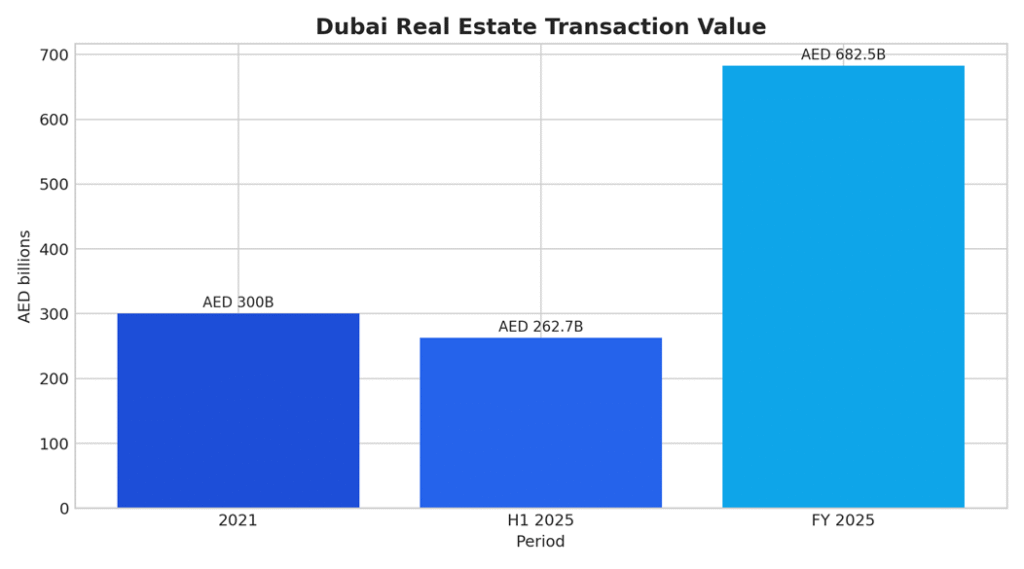
Investors often want to see evidence of launch-to-current price movement because it helps validate both capital appreciation and market acceptance. The comparison below uses representative launch prices from project listings and indicative current or currently listed asking prices where available; these should be treated as market guides rather than formal valuations.
| Developer | Project | Indicative launch price (AED mn) | Indicative current/listed price (AED mn) | Illustrative uplift |
| Beyond | Saria | 1.70 | 2.10 | 23.5% |
| Beyond | Kanyon | 2.40 | 2.75 | 14.6% |
| Select Group | Studio One studio | 0.485 | 0.768 | 58.4% |
| Select Group | Marina Gate 1BR | 0.850 | 1.250 | 47.1% |
| SOL Developer | SOL Levante selected unit | 0.780 | 0.900 | 15.4% |
| Dubai Properties | MJL 1BR indicative | 1.300 | 1.750 | 34.6% |
Future Projects and Forward Pipeline
Future pipeline matters because a large investor is buying into a developer franchise, not just a single unit. Beyond continues to expand its branded pipeline in Dubai Maritime City and prestige coastal zones; Select Group continues to benefit from a recognizable premium pipeline in established high-value districts; SOL remains focused on growth-corridor opportunities and product designed for accessible premium living; Dubai Properties continues to benefit from its broad institutional role within Dubai’s urban development framework.
For investor decision-making, the pipeline should be read in two ways: first, as a sign of the developer’s long-term commitment and relevance; second, as a supply variable that may increase competition in the same district. Investors should prefer developers whose future pipeline strengthens the district without oversaturating the same product niche.
ROI Framework for a USD 10 Million Allocation
At this capital size, investors should evaluate four layers of return: current income, capital appreciation, blended portfolio return, and exit-adjusted return after costs. Gross yield alone is insufficient. A professional underwriting model should include purchase costs, payment-plan staging, service charges, management fees, vacancy, furnishing, and resale assumptions at multiple hold periods.
- Select Group: most suitable for 5% to 7% gross premium-market yield profiles with stronger liquidity and more defensive pricing.
- Beyond: best modeled as a lower-current-yield but higher-appreciation opportunity tied to Dubai Maritime City maturation and waterfront scarcity.
- SOL Developer: suited to 6% to 8%+ gross yield scenarios where smaller units and growth corridors support stronger running returns.
- Dubai Properties: appropriate as a stable, confidence-enhancing sleeve where yield may be moderate, but district relevance and institutional trust are high.
Recommended Portfolio Structures
Conservative premium strategy
- 50% Select Group
- 20% Beyond
- 15% Dubai Properties
- 15% SOL Developer
Balanced investor strategy
- 35% Select Group
- 30% Beyond
- 20% SOL Developer
- 15% Dubai Properties
Appreciation-led strategy
- 40% Beyond
- 25% Select Group
- 20% SOL Developer
- 15% Dubai Properties
Conclusion for Investors
Dubai’s current property cycle is supported by measurable price growth, record transaction depth, long-term planning visibility, and a clear urban development agenda. For a USD 10 million investor, confidence comes not from chasing a single advertised ROI number, but from building a diversified, evidence-backed portfolio across developers that serve different strategic roles.
The most investor-friendly recommendation is to anchor the portfolio with Select Group, use Beyond for waterfront appreciation upside, add SOL Developer as the return enhancer, and include Dubai Properties Group to strengthen institutional confidence and broad-market exposure. This structure aligns current market momentum with the long-term supply and demand logic created by Dubai’s 2040 urban strategy.
